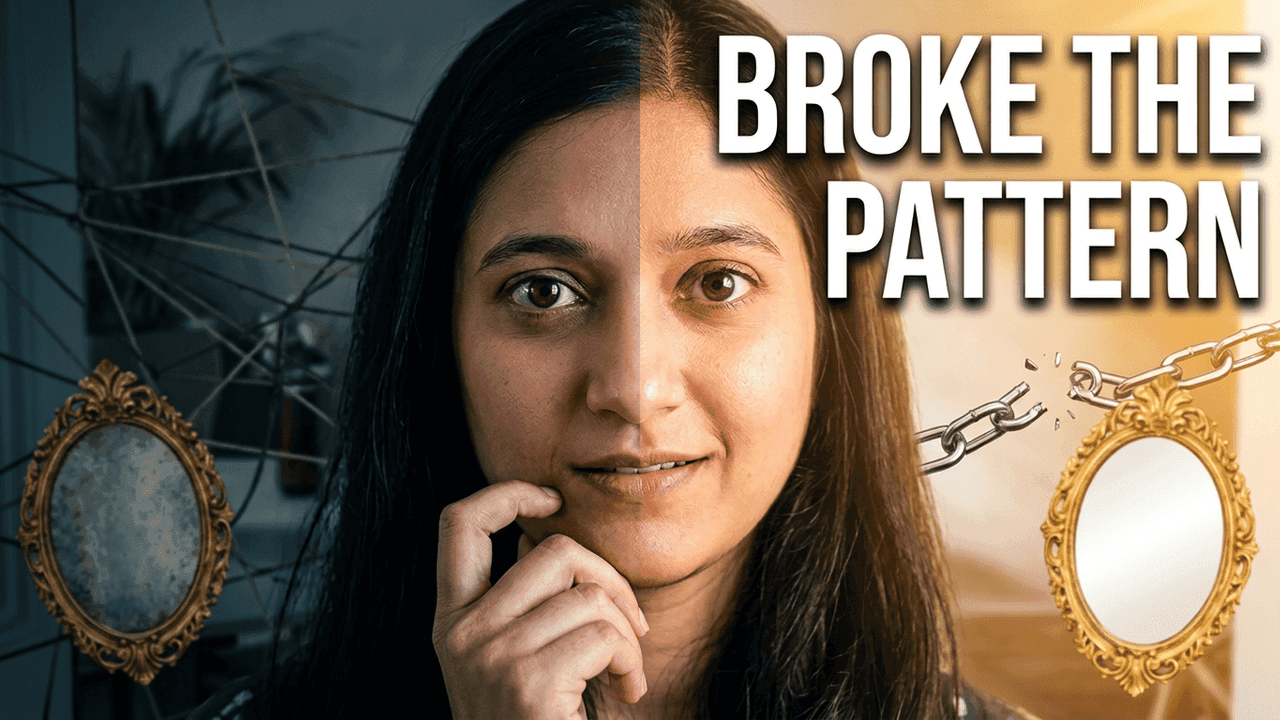
I had noticed that there was this loop going on in my life that was preventing me from taking the action I needed to take in order to move forward. Or if I did take action, I would notice that the action was very limiting — it just kept me a little bit above where I started, but never really at the high goals I wanted to reach.
I was wondering what was going on, and at that time I came across the concept of the upper limit, which really changed my life in a great way. Upper limit is a concept that Gay Hendricks talks about in his book The Big Leap — it’s a great read if you have the time. In it, he talks about how, as human beings, our happiness has an upper limit. We can only accept a certain amount of “happy” in our life. And if our happiness were to go beyond that limit, we find a way to sabotage it — and something happens.
It’s not just us taking action against ourselves either. It’s literal and physical. You can find yourself starting to get sick, or you can find yourself sabotaging the whole thing — physically, mentally, any way you can. And then you stop yourself from going there.
Recognizing My Own Upper Limit
What I noticed is that this is exactly what was happening with my own action-taking. The minute I had an insight and took a big action, something would go wrong. I’d end up in a bad job — one that gave me absolutely no time to work on my passions, where I was working until midnight and could barely touch my personal computer. Or my kids would get sick, and suddenly I had no time or energy to focus on the things I wanted to do.
I noticed a similar thing with exercising. For some reason, whenever I had a consistent workout routine going, I’d either end up getting sick or something else would happen to knock me off track.
I started to understand: this likely has to do with me upper-limiting myself. It’s almost like my body only wants to know a certain amount of energy it’s “allowed” to have, and me as a whole only wants to believe there’s a certain amount of money or happiness I can have. It’s almost like you spend your entire life waiting for the other shoe to drop — and that’s exactly what this is about.
Overthinking as a Symptom
I noticed that overthinking was actually a symptom of this pattern. I kept finding myself in these weird loops of overthinking everything. And in that overthinking — because my ego was taking over — I found myself back in my comfort zone, again and again, rather than relying on my intuition to expand further and transcend those limits.
Finding the Pattern
One of the biggest things that helped me break this loop was understanding patterns. Patterns are such a powerful thing to find within yourself — and if you can’t see them on your own, that’s exactly why you need a coach, or a friend, or someone who can reflect them back to you and say, “Listen, I think you’re going through a loop. I think you’re doing this again, where you’re limiting yourself.”
I found this within myself when I realized I was in a pattern of constantly attracting bad jobs — which was my reality for a couple of years, where I went from a good job, to a bad job, to a worse job. Once I recognized that pattern, I started finding myself on the up again, which is a very good thing.
Patterns show up everywhere — in your habits (three productive days followed by a Netflix binge that stops your momentum), in situations (finding yourself in a bad relationship over and over again), or in your health (getting sick right when you’re about to have a big breakthrough). These patterns are a mirror. They show you a loop that’s playing out in your life over and over again, just with different characters and different names. But essentially, the same thing keeps happening, and it’s holding you back from the next step you need to take.
These patterns usually point to a deep energetic and emotional wound that you’re carrying and need to resolve. When you’re able to find that wound, you’ll be able to transcend it and move beyond it.
My Story: The Pattern of Bad Managers
For me, the pattern showed up through my managers at work. The one before my last role was bad, but at my last role, the manager I got was even worse — and it triggered me in so many different ways because of the management style and everything that came with it. It was a really difficult period in my life. But I also learned a lot from it, and for that I’m eternally grateful.
With this manager, I finally asked myself: What is going on? Why is this pattern happening again and again in my life? What am I doing that keeps landing me in these bad work environments with bad managers?
As I sat with that question, I said, essentially, “Show me what I need to know.” I worked through my emotions around it, and once I let it all out — once I let it all purge — a quiet voice within me revealed what was really going on.
The Rule-Follower Wound
The first thing I saw was that I had always been a rule follower in my life. I did not break rules, and I was genuinely scared of breaking them. When I traced that back, I found it connected to a deeper wound.
This could point to a past life, or it could point to an ancestral wound — because DNA gets passed down from your ancestors to you, so if they went through something difficult, that emotion can still be stuck within you. You can interpret it either way; that part doesn’t matter as much as what you do with it. For me — since I’m Hindu and we believe in past lives and incarnations — it led me to a scene from an ancient Chinese dynasty, where I saw myself as one of the king’s men, a soldier or courtier of some kind. In that meditation, a scene flashed before me: my head was literally chopped off under charges of treason, for revealing secrets and breaking the rules of the court.
That’s where the wound came from: not telling the truth can get you killed. Not following the rules can get you killed. That was one of my shadows, and I had to accept that it’s okay not to explain my life to everybody else — that it’s no longer a matter of survival to volunteer everything going on in my life to someone else, and that it’s okay for me not to be a rule follower all the time. I can be a rebel. I can do things my own way. Just because a rule exists doesn’t mean it’s correct. I can pave my own path, and that doesn’t make me a bad or wrong person.
The Male Validation Wound
The second thing I uncovered was a childhood wound: the feeling that as a woman, as a girl, I always had to seek permission from a male figure — that I needed a man’s applause, or a man’s backing, in order to get ahead in life.
Almost all of my past managers, for a long time, had been men. Good or bad — some encouraged me a great deal, some pushed me, and some genuinely helped my career. But eventually I ended up with managers who were actually detrimental to my career, and that was a mirror being shown to me. It revealed that I believed I needed validation from a male figure — that I needed a man to see me in a certain light in order to progress, or else “it’s all done.”
I had to unlearn that pattern and resolve it — to understand that I don’t need anyone’s backing, male or female. I’m my own person, and I can do it my own way. Looking back, I realized that with my good managers, I had been using them as a kind of handicap, letting them do the work for me. I was letting them be my savior rather than becoming my own savior.
What Changed Once I Saw the Pattern
That was a huge epiphany for me, and once I recognized the pattern, things genuinely started shifting in my life. Even in that difficult role with the manager who wasn’t working out for me, I noticed the way I showed up at work — the way I interacted — started to change, because I was cutting off that dependency cord and coming into myself far more, rather than needing someone else to serve as proof of my worth.
It’s remarkable how these patterns show up across many different areas of life at once. I noticed the same dependency pattern in some of my friendships too — I had friends who were natural connectors, who introduced me to other people, and my social life was pretty much in their hands. Because they were such good friends, I let them build my community for me instead of building my own community my own way. It was wild to see how one single pattern had woven itself into so many different dimensions of my life.
How to Find Your Own Pattern
If you’re noticing loops like this in your own life, I’d urge you to ask: Why is this happening to me? What am I being shown here?
Then really vent all your emotions about the situation. You can do this in a lot of different ways — tap, journal, stand in front of a mirror and say your emotions out loud exactly as you feel them, however illogical or messy they seem. Just say it all out.
The key is being open to letting your emotions out completely — being 100% honest about how you feel about the situation, rather than talking yourself out of it or forcing positivity. Go a little crazy. Act like a belligerent child who’s mad about it. Allow yourself to be mad.
Once you’re done with that, the insight tends to arrive on the other side of the emotion — when you ask yourself, What is it that I’m not seeing here? What’s the lesson I need to learn? Sometimes the lesson points to a shadow side of yourself — something that triggers you because you don’t fully accept it in yourself. In my case, when people broke rules all the time, it triggered me — and I had to realize that I have a rule-breaker within me too. We all do. We’re all capable of everything, and I had to embrace that rebel side of myself in order to chart my own course instead of constantly following rules and following other people.
Why Insight Alone Isn’t Enough
A lot of people tell me, “I’ve had these findings through shadow work, but I still can’t integrate my new identity.” That’s usually because you’re not cutting cords with the old situation, and the new identity you once rejected.
In my case, I had to cut cords with the situation itself, with the aspects I was dealing with, and with the belief that this shadow side was “bad.” I had to do that energetically. Once I felt that release, I was able to release the whole situation — and that’s when I was able to embody the new identity.
Embodiment is a different process altogether — it’s rewiring, repeating the same truths to yourself over and over until they stick, going into a full “rampage” of self-declaration:
“No, I’m a rebel. I’ve always been a rebel. I love being a rebel. I don’t like following other people’s rules. I’m not here to follow rules — I’m here to create my own rules. I’m here to write my own book. I’m here to have other people follow me, and I’m here to be a leader. Leaders don’t follow rules. Leaders lead, and that is what I’m here to be.”
That’s the rampage — hyping yourself up after the emotions are out, anchoring yourself in the new identity you’ve chosen.
Emotional, Instinctual, and Mental Work Are All Necessary
One more thing worth mentioning: if you’re familiar with human design, we have three awareness centers — an emotional center, a spleen center (the fear/instinctual center), and the ajna, which is your mind or thinking center. There’s noise in all three, because these are our awarenesses.
So when someone says emotional work is better than energetic work, which is better than mindfulness work — that’s just not true. You need all three. They’re equally important. Not that you need to work all three every single day, but as you notice what’s coming up — “oh, I’m getting triggered” (emotional work), “I’m resisting adapting to this new thing” (fear work), “I’m overthinking this and stuck in analysis paralysis” (mind work) — you meet it with the right tool.
This is part of why I’ve never wanted to box myself in as “an energy coach” or “an emotional coach.” All three of these are equally important. It’s better to move through transformation using all the different tools available to you, rather than believing any single one holds all the answers. It’s also part of why I stepped back from talking about human design exclusively — any system that claims to be all you need is probably not the full truth.
Different things will speak to different aspects of your life. My advice is to stay open, notice what genuinely helps you, and pay attention to what opens up your awareness in a way that allows you to heal — and not just to heal, but to actually take action.
Move Toward Your Goal
Because that’s the real point. When we don’t move toward our goals, we find ourselves stuck in stagnancy — and that’s not what we’re here for. We’re here to expand. We’re here to rise.
I’d love to hear about the patterns you’ve conquered, or a pattern that’s still ongoing in your life that you can’t quite figure out. Let’s see if we can tackle it together.