
Your ego center in human design holds clues to your purpose and path in life. Lets unravel all of that in this blog.
Business strategy can only take you so far.
I know this because I tried doing everything “right.”
I followed business coaches. I experimented with multiple business models. I implemented proven strategies that worked for other people. From the outside, it looked like I was making smart, logical decisions.
But internally, most of those models felt deeply misaligned.
I procrastinated. I lost motivation. I would start strong, then slowly sabotage my own momentum. No matter how much mindset work I did, something always felt off.
That’s when I realized a hard truth:
If your business model is energetically wrong for you, no amount of strategy will make it sustainable.
This realization came into sharp focus once I started working with Human Design, specifically the Ego (Heart) Center.
Why Feeling Unaligned Leads to Procrastination and Self-Sabotage
When people feel stuck in business, they usually assume something is wrong with them.
They think they need:
- better discipline
- stronger motivation
- more systems
- a new strategy
But often, the real issue is energetic misalignment.
When your business doesn’t honor how you are designed to:
- experience motivation
- exchange energy for money
- use willpower
- define success
your body resists—quietly at first, then loudly.
This resistance shows up as procrastination, burnout, inconsistency, and the constant urge to pivot. Human Design doesn’t just explain why this happens—it shows you how to work with your energy instead of against it.
The Ego (Heart) Center in Human Design and Purpose
The Ego Center (also called the Heart or Will Center) governs:
- willpower
- motivation
- self-worth
- material resources
- how we relate to work and money
It is one of the most misunderstood centers in Human Design, especially in spiritual and entrepreneurial spaces where “meaning” is often emphasized over material exchange.
But here’s the truth:
Purpose without correct exchange does not sustain a defined Ego.
And this was one of the most important lessons I had to learn.
Defined Ego Center: Why Motivation Requires Fair Exchange
With a defined Ego Center, motivation is not generated by meaning alone.
It is generated through clean give-and-take.
If I am investing my time, energy, leadership, or focus into something, I need to receive something tangible in return. That return might be money, autonomy, time freedom, leverage, or recognition—but it must exist.
When it doesn’t, my motivation drops immediately.
Not because I’m lazy.
Not because I lack discipline.
But because my design is built around value exchange.
For years, I questioned why I could feel aligned with a mission yet still feel resistant to the work itself. Human Design gave me language for what my body already knew: purpose alone is not enough for a defined Ego.
When the exchange is aligned, I become focused, consistent, and powerful. When it isn’t, procrastination and self-sabotage show up almost instantly.
Gate 51 (Gate of Shock): Why I’m Always Pulled Back to Spiritual Work
I also carry Gate 51, and this gate has been impossible to ignore in my life. With Gate 51, you are a spiritual entrepreneur; meaning and spirituality must be part of your work.
No matter what I do—no matter how strategic, logical, or business-focused I try to be—I am always pulled back toward spirituality.
And when I resist that pull, the universe doesn’t gently nudge me.
It pushes.
Gate 51 is the energy of initiation and awakening. It brings transformation through disruption. It’s not about choosing spirituality because it sounds nice—it’s about being repeatedly redirected back to it, even when you try to move away.
Every time I drift too far into purely tactical or externally driven work, something happens that reorients me. A breakdown. A realization. A forced pause. A reminder that my purpose isn’t just to build something profitable—it’s to build something awakening, starting with myself.
Once I stopped fighting this and allowed spirituality to be a core ingredient in my business—not a side interest—everything began to make sense.
Gate 26 (Gate of Egoist): Why Time Freedom Has Always Been My True Goal
Then there’s Gate 26, which clarified something I had always felt but never trusted enough to claim. With Gate 26, you need time freedom and work that lets you earn more without working more.
For me, time freedom isn’t a luxury—it’s the goal.
Gate 26 is about leverage, efficiency, and influence. It is not here to grind endlessly. And when I look back, the moments in my life that felt the most blissful were not the ones where I was working the hardest.
They were the moments where:
- I earned more while working less
- my time felt spacious
- my nervous system could relax
- my work felt elegant instead of exhausting
This gate made something very clear: I am not designed to trade hours for dollars indefinitely. I am here to build systems, assets, and income streams that continue working after my effort is given.
That’s why passive income, digital products, and affiliate income didn’t just make sense strategically—they felt correct in my body.
When my time is free, my creativity expands.
When my effort is leveraged, life feels aligned.
That’s when work stops feeling heavy and starts feeling blissful.
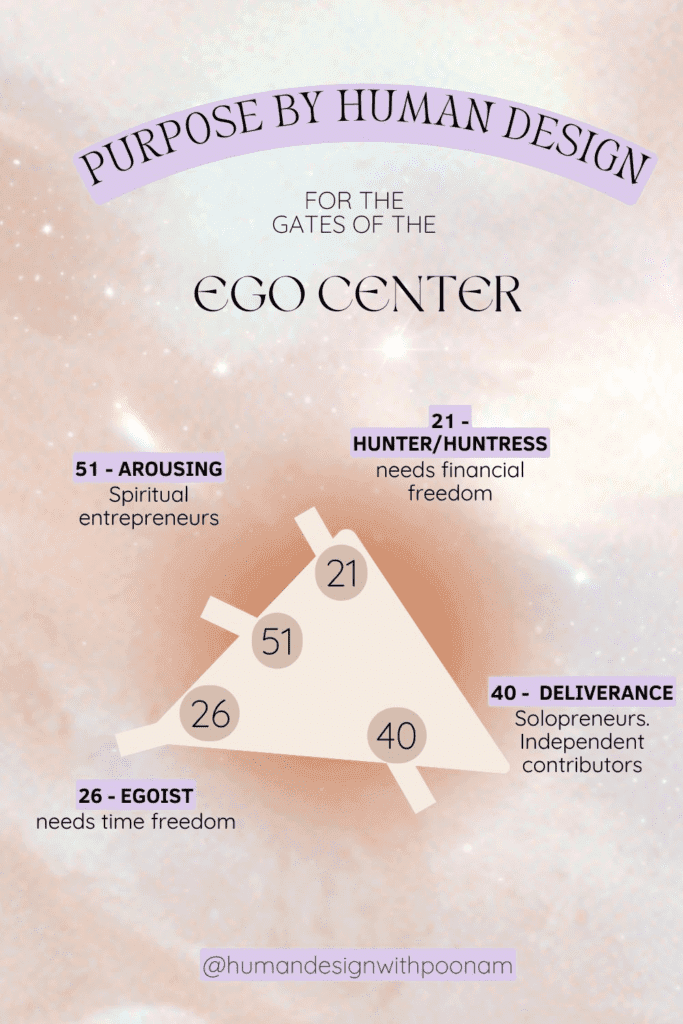
Gate 21 (Gate of Hunter/Huntress): Why Control Is Not My Primary Driver
Gate 21 is about control, authority, and financial autonomy. People with a Gate 21 activation often need complete control over resources and cannot tolerate having a boss or external authority. If you have this gate, you need control and autonomy; being told what to do or having a boss will drain you.
While autonomy matters to me, control itself is not my primary motivator.
I am not driven by the need to manage everything or dominate systems. What matters more is fair exchange and leverage, not control for its own sake. That distinction helped me understand why certain leadership-heavy or management-intensive business models never felt fully correct for me, even though they were profitable.
Gate 40 (Gate of Deliverance): Why being the primary breadwinner is not what I chase
While some people are designed to be the steady provider or primary breadwinner for others, that role has never been what truly motivates me. Being responsible for ongoing output or holding everything together for a group does not energize me, even when the exchange is fair. What does matter deeply to me is time freedom, flexibility, and space to create.
If you have this gate, you need alone time and do best as an independent contributor or solopreneur.
With a Line 2 profile, I need regular alone time for creativity and clarity—not because of a work–rest dynamic or obligation to others, but because that hermit energy is how my insight and inspiration naturally emerge. When my schedule is too full or my work is built around constant responsibility, my creativity shuts down. When I have space, my best ideas and most aligned work flow effortlessly.
What If You Have an Open Ego Center?
If your Ego Center is completely open, your experience is different.
You are adaptable. You can sample many business models and succeed in various environments. But your lesson is not about proving worth through work.
Open Ego beings burn out when they try to compete with defined Ego energy. Alignment comes not from pushing harder, but from choosing consciously and honoring your limits.
Why “What Makes Money” Is the Wrong Question
One of the biggest traps I see is asking:
“What business model makes the most money?”
A better question is:
“What business model allows me to show up consistently without burning out?”
Just because a business model works financially does not mean it is correct for your design. When your business aligns with your Ego Center, motivation becomes natural, consistency improves, and income flows with less force.
How My Business Changed When I Followed My Design
Everything shifted once I stopped chasing external strategies and started honoring my energy.
Transitioning into a passive income model—using digital products and affiliate income—was not just a strategic decision. It was an energetic correction.
I stopped forcing motivation.
I stopped fighting myself.
And my business finally began supporting my life instead of consuming it.
Ready to Decode Your Purpose Using Human Design?
If you’ve been struggling to understand your purpose—and how it translates into aligned work and income—Human Design can bring the clarity you’ve been searching for.
👉 Sign up for the free Purpose to Profits Mini Course.
Inside, you’ll learn:
- how to identify your energetic strengths
- how to align purpose with income
- why certain business models feel easy while others feel exhausting
Because strategy matters—but alignment is what makes it sustainable.
