Manifestation is often portrayed as something expansive, empowering, and freeing. It’s supposed to feel light, aligned, and almost magnetic. Yet for many people, the lived experience of manifestation looks very different. Instead of feeling energized, they feel mentally exhausted. Instead of expansion, they experience pressure, frustration, and a constant sense of “trying.”
If manifestation feels draining rather than expansive, it’s not because you’re doing it wrong. More often than not, it’s because manifestation is being approached from a state of contraction rather than alignment.
This is something I’ve experienced myself—more than once. Even after years of personal development, energy work, and subconscious rewiring, I notice that if I let life take over and lose intentionality, I can fall right back into old patterns. I start relying on rituals, actions, and effort as if manifestation is something that must be earned through constant doing.
That moment is always my signal to pause.
Because manifestation doesn’t become draining because you’re manifesting too much—it becomes draining when you’re manifesting from the wrong internal state.
- The Root of the Exhaustion: Manifesting from Contraction
- Why We Default to “Doing” Instead of “Being”
- The Misunderstanding of “Becoming” Your Future Self
- What Alignment Actually Means in Manifestation
- My Personal Example: When Alignment Changed Everything
- The Role of the Subconscious and Emotional Body
- Why Doubt Doesn’t Mean Manifestation Is Failing
- Why Manifestation Feels Draining (And How to Shift It)
- Final Thoughts: Manifestation Is About Congruence, Not Effort
- Ready to Go Deeper?
The Root of the Exhaustion: Manifesting from Contraction
At its core, manifestation feels exhausting when it’s driven by contraction. Contraction shows up as urgency, pressure, fear of failure, and an underlying belief that something is missing. Even if the conscious mind is repeating affirmations or visualizing success, the nervous system may still be operating from scarcity.
When that happens, manifestation becomes work.
This is where many people get stuck. They believe that if they just do more—more rituals, more journaling, more affirmations, more action—then results will eventually follow. And when they don’t, the exhaustion deepens.
The truth is, this way of approaching manifestation is not intuitive—it’s conditioned.

Why We Default to “Doing” Instead of “Being”
Most of us were raised in systems that taught us to equate time, effort, and productivity with worth. We learned early on that money comes from effort, stability comes from control, and safety comes from predictability. Even when someone steps into spiritual or manifestation work, those subconscious programs don’t simply disappear.
As a result, manifestation often becomes another productivity project.
People unconsciously believe that if they are “being” instead of “doing,” nothing will happen. That rest is laziness. That alignment must look like discipline. That effort is proof of commitment.
But if you look closely at how wealth actually works in the world, you’ll notice something interesting.
Those who have significant financial expansion rarely earn money solely through time and effort. Wealth is created through leverage—investments, ownership, systems, and risk. Money begins to work for them rather than the other way around.
For those who were not born into this way of thinking, this concept can feel foreign—and even threatening. Risk feels unsafe. Letting go of effort feels irresponsible. And as we get older, with more responsibilities and people depending on us, our tolerance for risk shrinks even further.
So instead, we try to manifest through effort.
And that’s where the exhaustion begins.
The Misunderstanding of “Becoming” Your Future Self
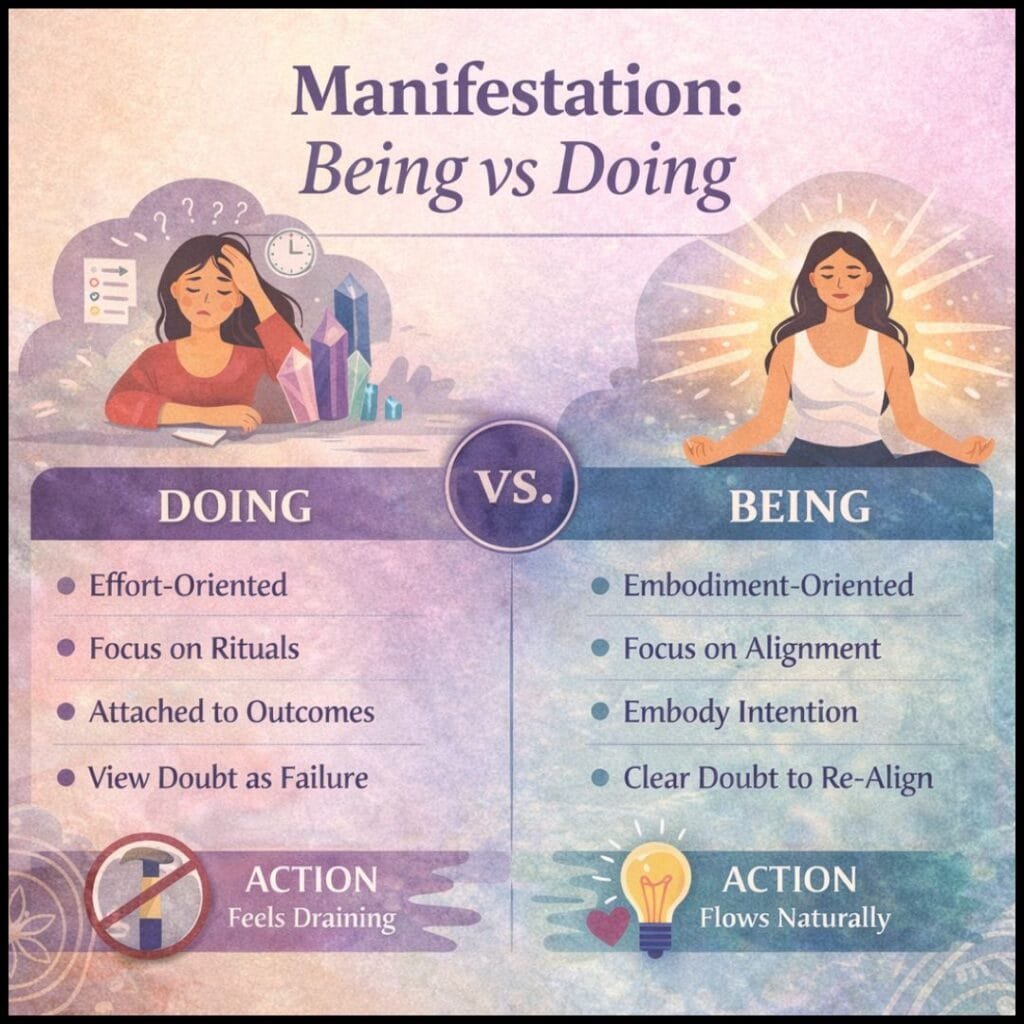
Many manifestation teachings talk about “becoming” your future self. When I first encountered this idea, I misunderstood it in the same way many people do. I thought becoming meant doing more.
I believed I needed to wake up earlier, show up differently, act more confident, follow certain routines, and replicate external behaviors associated with success. But once again, the emphasis was on action rather than internal alignment.
What I eventually learned—through lived experience, not theory—is that becoming happens internally first.
True embodiment doesn’t start in behavior. It starts in the mind, the emotional body, and the subconscious. When internal congruence is present, action becomes automatic. There is no forcing, no pushing, and no need to convince yourself to move forward.
Alignment doesn’t require rituals to “activate” it. Rituals can support alignment, but they do not create it.
What Alignment Actually Means in Manifestation
Alignment is often misunderstood as being high-vibe, positive, or emotionally elevated all the time. But alignment is not about mood—it’s about congruence.
Alignment occurs when your thoughts, beliefs, emotions, nervous system, and subconscious expectations are all oriented toward the same outcome. When that happens, the body naturally moves toward actions that support that reality.
This is why inspired action doesn’t feel like work.
Inspired action is not effortful because it doesn’t come from resistance. It comes from clarity. The action feels obvious, timely, and often even playful. There is a sense of “of course this is what I do next,” rather than “I should be doing this.”
When manifestation feels draining, it’s usually because action is being taken before alignment is established, rather than as a result of it.
My Personal Example: When Alignment Changed Everything
There was a moment recently when I found myself at a crossroads. I had been promoting an affiliate program for months when the creator suddenly closed the doors. Overnight, the path I had been walking disappeared.
At first, I reacted from the mind. I went back to rituals. I tried to “figure it out.” I stayed busy. But nothing shifted.
That’s when I realized I wasn’t aligned—I was coping.
So I stopped.
Instead of forcing clarity, I focused on realignment. I cleared emotional noise. I addressed subconscious fears. I grounded my intention without attaching urgency to it. And then I started asking questions from a detached, curious place—as if I were playing a fun game rather than trying to survive.
That’s when clarity arrived.
I knew exactly what felt lighter. I knew what felt dense. The next steps became obvious—not because I thought harder, but because my internal state changed.
And this action is different. I don’t just want to call it inspired action because sure it is. But this is inspired, automatic action. It is action that flows through your being. It does not need the same thought process as actions that stem from our busy minds though.
This is how manifestation actually works.
The Role of the Subconscious and Emotional Body
We often underestimate how powerful the subconscious and emotional body are in shaping outcomes. The subconscious does not respond to effort—it responds to familiarity and coherence.
When you repeatedly bring your end goal into the subconscious—through intention, emotional neutrality, and focus—it begins to generate pathways automatically. Ideas emerge. Decisions feel clear. Synchronicities appear.
This isn’t mystical. It’s neurological.
You are constantly processing information below conscious awareness. When the subtle body is aligned with a goal, it starts filtering reality in ways that support that outcome.
But this requires focus, not force.
Why Doubt Doesn’t Mean Manifestation Is Failing
One of the biggest mistakes people make is interpreting doubt as failure. Doubt is not a sign that manifestation isn’t working—it’s feedback.
Doubt points to a place where alignment has slipped. And instead of suppressing it or “thinking positive,” the real work is to investigate it.
When doubt arises, the goal isn’t to push forward harder. The goal is to restore congruence.
This is where mastery comes in.
Professional athletes don’t give up when the first attempt doesn’t land. They refine technique. They improve execution. They stay with the path once it’s shown to them.
Manifestation works the same way.
If an inspired action doesn’t produce results immediately, it doesn’t mean the path was wrong. It means there is something to refine—execution, clarity, skill, or consistency.
Exhaustion happens when people expect manifestation to bypass mastery.
Why Manifestation Feels Draining (And How to Shift It)
Manifestation feels draining when:
- You rely on rituals instead of internal congruence
- You push action instead of allowing alignment to lead
- You equate effort with worth
- You suppress doubt instead of addressing it
- You try to “stay positive” rather than stay coherent
Manifestation becomes expansive when:
- Alignment happens internally first
- Action flows naturally rather than being forced
- Doubt is used as data, not a verdict
- Focus replaces hustle
- The nervous system feels safe enough to receive
This is not about doing less. It’s about doing from the right place.
Final Thoughts: Manifestation Is About Congruence, Not Effort
Manifestation was never meant to feel exhausting. When it does, it’s usually a sign that you’re trying to create from effort rather than embodiment.
The shift happens when you stop trying to force outcomes and instead allow alignment to lead. From that space, action becomes inevitable—and sustainable.
That’s when manifestation stops feeling like work and starts feeling like expansion.
Ready to Go Deeper?
If this perspective resonates with you and you’re ready to approach manifestation in a way that feels aligned, grounded, and sustainable, I have put together a curated list of manifestation programs that I’ve personally tested and reviewed.
These programs focus on:
- Subconscious rewiring
- Emotional regulation
- Energetic alignment
- Embodied action
- Long-term integration (not quick fixes)
👉 Explore the top manifestation programs here and find the support that matches where you are right now.
You don’t need to force manifestation. You need to align with it.